If no significant actions -- benefit reductions and/or tax increases -- are taken, Social Security will be able to pay only 77% of promised benefits starting in 2034. That assumes immigration will remain at about one million annually.
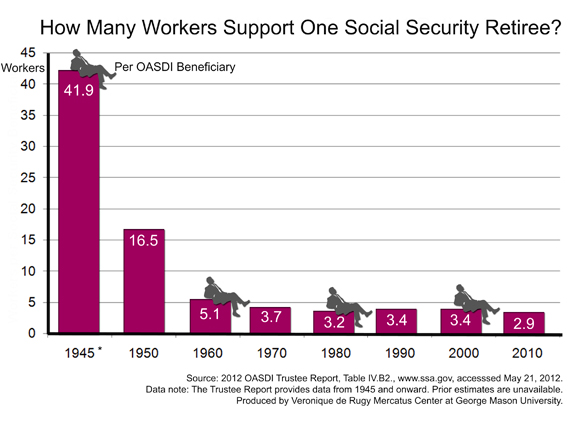
Since Social Security is a pay-as-you-go system and not a savings account -- at any given time, payments to current retirees are supported by the earnings of current workers -- the ratio of workers to retirees is key to making those payments. The higher the ratio, the better the chances of payments as usual.
Immigrants have a higher birthrate than the native-born, so that the number of workers contributed into the system by a given number of immigrants is higher than it is from the same number of native-born. That's a plus for the numerator in the ratio.
The native-born are older, and a larger population, so as they age they add to the ratio's denominator in greater numbers. As a result, the ratio of workers to retirees has been declining. Without immigration, it would have declined more, and the date of the reduction in benefits would occur even sooner than 2034.
To literally drive this point home (into the home of the American voter, perhaps), The Economist observes
AS PRESIDENT DONALD TRUMP attempts to reduce immigration into America, new research suggests how rapidly that strategy is likely to disadvantage many of his most loyal supporters. In 2016, there were more deaths than births among America’s non-Latino white population. The future quality of life of this aging, shrinking population increasingly depends on two factors: sustained high fertility amongst minority groups already in the country—and continued immigration.
Migrants are a particularly important factor in sustaining the size of America’s workforce: in 2014, 80% of foreign-born inhabitants were aged 18 to 64 compared to 60% of those native born.The emphasis is mine.
Assuming continued trends in longevity and native-born birthrates, there are only two levers that can be pulled to maintain current benefit payments beyond 2034: increase the social security tax; increase the workforce. Or, of course, some combination of the two.
In the early years of the Social Security Administration, each retiree was supported by a dozen or more workers. Now, the ratio is closer to 3:1 and declining, as illustrated by this graphic from Mercatus Center at George Washington University:
We
live longer than we used to, which means that we collect those Social
Security retirement payments longer, too. And that means that we need a
continual infusion of new workers to support those payments.
Immigrants
add to the annual number of new workers in two ways. Some are
immediate additions; others come later as babies born to immigrant
mothers mature into working adults. During the period 1970 to 2014
births to U.S. born women have declined, while those to resident
immigrant women have increased, according to a report by Pew Research.
Total U.S. births increased during that period; the increase was due to
births to immigrant mothers. The trend of decreasing birth rate among
U.S.-born women shows no sign of changing. A decrease in immigration
will mean a decrease in the total U.S. birth rate.
Such
a decrease would be troubling for the continued solvency of Social
Security, as a decrease in the birth rate -- assuming, of course, that
the retiree population continues to grow -- would mean fewer workers
paying taxes to support the Social Security payments for each of those
retirees. (In the interests of full disclosure: I expect to be one of "those retirees." So, yes, I have a vested interest in this. I'm guessing that you do, too.)
A decrease in annual immigration into the country would make the problem even worse as fewer immigrant workers will arrive to immediately add themselves to the workforce.
A decrease in annual immigration into the country would make the problem even worse as fewer immigrant workers will arrive to immediately add themselves to the workforce.
The Social Security Administration has prepared an extensive report
on the effects to be expected of the future results of current
demographic trends. It includes the assumption that immigration into
the Unites States will continue at about 1 million annually. The report
was prepared prior to the start of the Trump presidency.
Most Americans currently support legal immigration at current or greater levels, according to a Pew Research Center report. My guess is that a wider understanding of the economic benefits of immigration -- such as its positive effects on Social Security solvency, as discussed here -- would result in even more support for these positions. The findings of the report reveal several indicators of popular support for continued and even greater immigration:
This seems not surprising -- why would a group that does not want to call attention to itself condone criminal behavior, therefore inviting increased scrutiny by law enforcement and adverse publicity in the media?
The Social Security issue discussed here is just one part of the overall national economic impact of immigration. Broadly speaking, only two factors can contribute to an increase in GDP: An increase in the number of workers, and an increase in worker productivity.Most Americans currently support legal immigration at current or greater levels, according to a Pew Research Center report. My guess is that a wider understanding of the economic benefits of immigration -- such as its positive effects on Social Security solvency, as discussed here -- would result in even more support for these positions. The findings of the report reveal several indicators of popular support for continued and even greater immigration:
- 45% of Americans correctly say that most immigrants living in the U.S. do so legally; 35% say most immigrants are living illegally.
- Three-quarters of immigrants are, in fact, legal immigrants.
- Most Americans are comfortable with immigrants, even those who are unauthorized: 65% say that unauthorized immigrants are no more likely than U.S. citizens to commit serious crimes; 71% say that such immigrants mostly fill jobs that citizens do not want; 73% of those who come into contact with immigrants who are not fluent in English say that the experience is not troubling enough to be a concern.
This seems not surprising -- why would a group that does not want to call attention to itself condone criminal behavior, therefore inviting increased scrutiny by law enforcement and adverse publicity in the media?
The demographics of the American population make it clear that an increase in the number of workers will happen only with continued, or even increased, immigration. (It seems unlikely that a government directive that native-born women should increase their fertility -- should such a thing leap out of the realm of the hypothetical and attempt to land itself in the real world -- would have the desired, or any desirable, effect.)
Notwithstanding majority opinion, significant numbers of Americans are unhappy with, or uncomfortable with, immigration. If it were up to me, I would want to understand why they feel that way, and address their concerns within the context of how they benefit from immigration. I'd be willing to bet that some, maybe most, of them would end up deciding that the loss of Social Security benefits would be a greater discomfort.
Social Security benefits have already been decreased by delaying the full benefits age. Demographic results that are baked in to the population argue for further benefits reductions immediately so as to possibly minimize the 23% reduction in all pension payments that will take place in 2034 without an increase in the Social Security system's funding. That increase in funding can come only from increased taxation rates, or an unexpected increase in the number of workers, or a combination of the two.
2034 is sixteen years in front of us. Suddenly, that doesn't seem like a long time.

