Showing posts with label immigration. Show all posts

Wednesday, July 17, 2019

My open letter to the current occupant of the White House


Dear Mr. Trump:

I have several bones to pick with you. 

Before getting to the meat of the matter:  Thank you for having a fill-in-the-blanks form on the White House website for use in writing to you.  However, it did not allow me to send you this letter.  The form accepts only something that would be much shorter, and, besides, it fails to allow this nice spacing between paragraphs so that there is no reading enjoyment for you in a letter's final appearance.  I think you will find the visuals of this posting to be much more pleasing to your eye.

Let me introduce myself.  In some ways, I am a member of the demographic to which you hope to appeal:  WASPish, on Medicare, former (now retired) small business owner.

Don’t get excited.  I live in California and am a card-carrying Democrat (at this point, I can’t blame you for being a bit deflated), I have college degrees, I disagree with you on. . .well, I cannot think of a single area of agreement with regards to your conduct as president, and I'll leave it at that. . .and I am the father of a daughter whose mother is a member of a racial minority.

Being a parent is, of course, an intensely personal thing.  You have children, so you probably understand that.

Then let me ask you something:  How would you feel if a highly visible and influential public figure were to take some characteristic of one or more of your children and say that characteristic is such that your offspring should leave home in America and go live somewhere else?  If that public figure were the nation’s president – yes, I’m speaking about you; this is not hypothetical – would you feel the stirrings of an increasingly threatening environment that was being built to “cleanse” the country of people of that characteristic?  I am feeling that way; I imagine you would, too, if the shoe were on the other foot.

And now, if I am understanding what you are also saying – and I believe that I am – you maintain that it’s really all about people who “hate our country” because they disagree with you and they say so.  After all, you say, you don’t “have a racist bone” in your body; instead, you blame all this on others who “hate.”  As if that makes a difference.  

It doesn’t.
 
In your mind, disagreement equals hate.  I have already told you that I cannot think of a single area about governing policy and practice in which we would agree; to you, does that mean that I hate the U.S. and should leave for somewhere else?  Apparently so.

Unfortunately for you, our country has a two-and-a-half century history that says otherwise.  You cannot change that.  True enough – that history includes a lot of evolution in the country’s diversity of cultures and its acceptance of that diversity, but it is an evolution that in fits and starts, in two-steps-forward-and-one-backward, has never stopped, and has never been undone.  It’s an imperfect history, but taken in total it is an honorable one.

But, I guess you think you can change all that.  That’s very unfortunate for our country, because that kind of change will diminish it.

I understand that you are playing a political game here in conflating racial appearances and differences of opinion with what you label as too much immigration into the U.S.  It’s your marketing plan for the next election.  Everybody needs a marketing plan, right?

Your plan, though, is hurtful to our country.  In fact, upon retiring from the presidency Ronald Reagan put it this way:  “If we ever closed the door to new Americans, our leadership in the world would soon be lost.” 

(Yes, I know that particular sentence shows up in the recent U.S. House of Representatives Resolution 489 that has you on edge, but I thought you ought to know of its origin.)

Your insecurity about disagreements goes beyond the issues of immigration.  But you are the one who has ginned-up anxieties about immigration, diversity and cultural change, so I think it’s fair for me to make the connection.

If you insist in trying to change America’s history and erase its progress, all that you will accomplish is to diminish the nation’s stature by attempting to make it into some kind of “fortress America” instead of the “welcoming America” that it had become prior to your presidency.  We already know that building on the honorable successes of the past yields a better future.  Doing otherwise results in diminishment; unchecked, that would end in irrelevancy.

You will fail, because you have now made things very, very personal and very much about family, country and their combined future.  And I believe I say that not only for myself, but also on behalf of a great many others.

Sincerely,

Garry Herron

Thursday, June 28, 2018

If Americans like the idea of getting their Social Security payments, then they might want to have more (not less) immigration into the U.S.

Immigration into the United States has been, and will continue to be, a net positive for the solvency of America's Social Security pension payments system.  Keeping incoming immigration numbers level when compared with past numbers is good; more would be better; fewer will be bad; if reduced to none -- disastrous.

If no significant actions -- benefit reductions and/or tax increases -- are taken, Social Security will be able to pay only 77% of promised benefits starting in 2034.  That assumes immigration will remain at about one million annually.

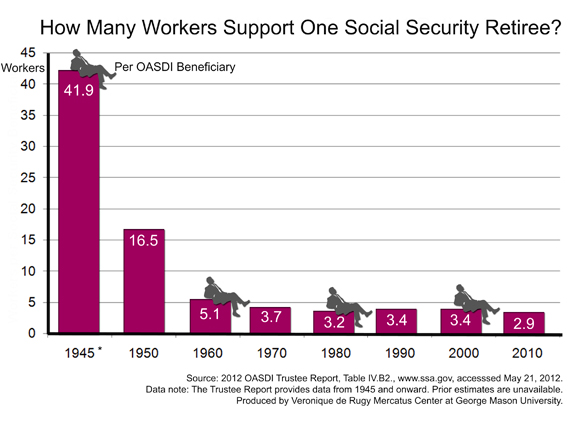
Since Social Security is a pay-as-you-go system and not a savings account -- at any given time, payments to current retirees are supported by the earnings of current workers -- the ratio of workers to retirees is key to making those payments.  The higher the ratio, the better the chances of payments as usual.

Immigrants have a higher birthrate than the native-born, so that the number of workers contributed into the system by a given number of immigrants is higher than it is from the same number of native-born.  That's a plus for the numerator in the ratio.

The native-born are older, and a larger population, so as they age they add to the ratio's denominator in greater numbers.  As a result, the ratio of workers to retirees has been declining.  Without immigration, it would have declined more, and the date of the reduction in benefits would occur even sooner than 2034.

To literally drive this point home (into the home of the American voter, perhaps), The Economist observes
 AS PRESIDENT DONALD TRUMP attempts to reduce immigration into America, new research suggests how rapidly that strategy is likely to disadvantage many of his most loyal supporters. In 2016, there were more deaths than births among America’s non-Latino white population. The future quality of life of this aging, shrinking population increasingly depends on two factors: sustained high fertility amongst minority groups already in the country—and continued immigration.
 Migrants are a particularly important factor in sustaining the size of America’s workforce: in 2014, 80% of foreign-born inhabitants were aged 18 to 64 compared to 60% of those native born.
The emphasis is mine.

Assuming continued trends in longevity and native-born birthrates, there are only two levers that can be pulled to maintain current benefit payments beyond 2034:  increase the social security tax; increase the workforce.  Or, of course, some combination of the two.

In the early years of the Social Security Administration, each retiree was supported by a dozen or more workers.  Now, the ratio is closer to 3:1 and declining, as illustrated by this graphic from Mercatus Center at George Washington University:

We live longer than we used to, which means that we collect those Social Security retirement payments longer, too.  And that means that we need a continual infusion of new workers to support those payments.

Immigrants add to the annual number of new workers in two ways.  Some are immediate additions; others come later as babies born to immigrant mothers mature into working adults.  During the period 1970 to 2014 births to U.S. born women have declined, while those to resident immigrant women have increased, according to a report by Pew Research.  Total U.S. births increased during that period; the increase was due to births to immigrant mothers.  The trend of decreasing birth rate among U.S.-born women shows no sign of changing.  A decrease in immigration will mean a decrease in the total U.S. birth rate.

Such a decrease would be troubling for the continued solvency of Social Security, as a decrease in the birth rate -- assuming, of course, that the retiree population continues to grow -- would mean fewer workers paying taxes to support the Social Security payments for each of those retirees.  (In the interests of full disclosure:  I expect to be one of "those retirees."  So, yes, I have a vested interest in this.  I'm guessing that you do, too.)

A decrease in annual immigration into the country would make the problem even worse as fewer immigrant workers will arrive to immediately add themselves to the workforce.

The Social Security Administration has prepared an extensive report on the effects to be expected of the future results of current demographic trends.  It includes the assumption that immigration into the Unites States will continue at about 1 million annually.  The report was prepared prior to the start of the Trump presidency.

Most Americans currently support legal immigration at current or greater levels, according to a Pew Research Center report.  My guess is that a wider understanding of the economic benefits of immigration -- such as its positive effects on Social Security solvency, as discussed here -- would result in even more support for these positions.  The findings of the report reveal several indicators of popular support for continued and even greater immigration:
  • 45% of Americans correctly say that most immigrants living in the U.S. do so legally; 35% say most immigrants are living illegally.
  • Three-quarters of immigrants are, in fact, legal immigrants.
  • Most Americans are comfortable with immigrants, even those who are unauthorized:  65% say that unauthorized immigrants are no more likely than U.S. citizens to commit serious crimes; 71% say that such immigrants mostly fill jobs that citizens do not want; 73% of those who come into contact with immigrants who are not fluent in English say that the experience is not troubling enough to be a concern.
Other studies have shown that the presence of immigrants, especially unauthorized immigrants, has the effect of lowering crime rates.

This seems not surprising -- why would a group that does not want to call attention to itself condone criminal behavior, therefore inviting increased scrutiny by law enforcement and adverse publicity in the media?

The Social Security issue discussed here is just one part of the overall national economic impact of immigration.  Broadly speaking, only two factors can contribute to an increase in GDP:  An increase in the number of workers, and an increase in worker productivity.

The demographics of the American population make it clear that an increase in the number of workers will happen only with continued, or even increased, immigration.  (It seems unlikely that a government directive that native-born women should increase their fertility -- should such a thing leap out of the realm of the hypothetical and attempt to land itself in the real world -- would have the desired, or any desirable, effect.)

Notwithstanding majority opinion, significant numbers of Americans are unhappy with, or uncomfortable with, immigration.  If it were up to me, I would want to understand why they feel that way, and address their concerns within the context of how they benefit from immigration.  I'd be willing to bet that some, maybe most, of them would end up deciding that the loss of Social Security benefits would be a greater discomfort.

Social Security benefits have already been decreased by delaying the full benefits age.  Demographic results that are baked in to the population argue for further benefits reductions immediately so as to possibly minimize the 23% reduction in all pension payments that will take place in 2034 without an increase in the Social Security system's funding.  That increase in funding can come only from increased taxation rates, or an unexpected increase in the number of workers, or a combination of the two.

2034 is sixteen years in front of us.  Suddenly, that doesn't seem like a long time.


Thursday, August 7, 2014

U.S.A.: Central American children on the border -- let's interrupt this hysteria and consider some facts

Why do people leave home to move to another country?  Why do they do this when their transit includes riding on top of a train called La Bestia?  (You probably don't have to look up the English translation to figure out what it means.)  Why do this when riding on La Bestia might be the safest part of the trip?

People voluntarily uproot themselves, leave their homes and move to another country for only a few reasons:  long-term personal safety and security are always among the top reasons, along with pursuing opportunities for education, comfort and wealth.  Americans--other than Native Americans--are exclusively either immigrants, or are descendants of immigrants, slaves and others who were forcibly brought here in some indentured manner; most of us have American pedigrees that originate within the last three hundred years, a relatively short time span in the great scheme of things that we call civilization. 

Despite this history, the American consciousness--including especially our politics--has occasionally been obsessed with an almost hysterical fear that our country is being overwhelmed with outsiders who are--for purposes of this controversy--lumped together as "illegal immigrants."  Now is one of those occasions.

Leaving aside for the moment the inherent absurdity that a nation based on the pedigree of immigration can be overwhelmed by any number or type of additional immigrants--out of a current population of 315 millions, the undocumented or illegal population numbers about 11 millions, or roughly 3.5% of the total--let's focus only on the immediate "crisis" at hand, which is described as the illicit arrival--many via La Bestia--over the last almost a year of 57,000 illegally-immigrated minors (children) from Central America.  That's right:  children riding on top of La Bestia.

Here's something that might come as a surprise to most people:  these 57,000 are not necessarily "illegals."  Almost certainly some are, but with equal certainty some--perhaps the majority--are not.

Granted, 57,000 people in one place at one time can be a lot of people.  But we're not talking about all of these people being in one place at one time.  They are spread out over a huge geography, and over some significant amount of time.  True, more have probably arrived since that number was counted, but some have already been returned to their countries of origin, all of which is a normal state of affairs.

Yes, believe it or not, there is some normalcy in this "crisis" story.

But let's work with that number:  57,000 added to 315 million works out to .02%, which is two one-hundredths of a percent of America's total population.  That is a pretty small, almost miniscule, and proportionally insignificant, addition to the nation's count of residents.

Admittedly, managing to a situation such as this costs the country something, some of which was anticipated and therefore planned for.  These 57,000 people are seeking asylum in the United States; asylum is a legal status, granted upon judicial review, and it has been around for decades.  In particular, a specific law that was adopted by the U.S. six years ago in the waning months of the Bush 2 administration could apply to many of these 57,000 since it was crafted to offer asylum to Central American children who are determined to be at risk of exploitation by gangs and criminals (sometimes organized) in their home countries.

There's a much larger context to asylum than just the current plight of children from Central America.  The United States offers asylum for many reasons, and the offers go out to people all over the world.  In the years 2003 to 2012, the United States granted asylum to over 250,000 people from more than 100 countries.

During that time period, fewer than 10,000 of those grants of asylum were made to people from all Central American countries combined.  Almost the same number of Ethiopians--about 9500--were granted asylum.  Over in the Caribbean, Haiti by itself accounted for over 16,000 grants of asylum.  China had the most:  almost 65,000.  (See the New Republic article by Danny Vinik that analyzes asylum data from the U.S. Government, and then presents it in a really nifty interactive map.)

Put all of this together--American history; immigrants being spread out over space and time; the legal and historical context of asylum--and the case for calling this situation a "crisis" is just not convincing.  If there is anything of crisis in this, it is a crisis of our morals and ethics; but let's pass on discussion of that, at least for now, because my working assumption is that the great majority of Americans, when confronted with the reality of endangered children, will choose to provide those children with safety instead of returning them to an environment of hostility and criminal compulsion; especially when at least some of the root causes of that criminality emanate from America's own social and legal behaviors towards cocaine, heroin and other drugs.

Nonetheless, working through thousands of asylum-seekers is time-consuming and costly.  I don't know what is the "right thing to do" for these people as individuals, because each one will have a different story.  But taken together as a group, I know that the legalities of asylum require that due process be provided.  America is, after all, a legalistic society.  Tedious though that might be at times, it is our adherence to the "rule of law," as we call it, that helps us to build and maintain our leading position among the world's nations.

Additionally, in the current case of the Central American children, it is in the self-interest of law-abiding Americans to do whatever is possible and practical to show them that there are better ways to live than to return to an environment that could make them a part of criminal enterprises supplying illicit and dangerous drugs to the North American market.  If we are law-abiding Americans, do we want to encourage young people to pursue criminal lifestyles that ultimately profit from the continuing use and purchase of dangerous drugs in the United States?  I think not. 

The larger question, of course, is this:  Will the United States be welcoming to immigration, or hostile to it?  There's a general feeling in this country that we Americans are opposed only to illegal immigration, and welcoming to legal immigration, and that this means that the United States is anything but hostile to immigration.  Unfortunately, the whole story is that the U.S. provides immigration visas to only a small fraction of the apparently-qualified applicants, and so because of that fact we therefore severely restrict the number of foreign people who can legally move into the country and seek to become naturalized citizens.

Some will say that this is as it should be because the United States is populous enough as it is.  Certainly, the size of the population bears watching, but also consider the nature of that population, and realize that without sustained, large numbers of immigrants--more than the U.S. currently allows in legally--the country faces two undeniable demographic shortcomings:  first, large numbers of highly-skilled potential immigrants are denied access to America and therefore go elsewhere, enriching the business and innovation cultures of those other countries instead of doing so in the U.S.; and, second, America's population will age much faster with less immigration than it will with more immigration, which means fewer workers making money, paying taxes and supporting programs like Social Security and Medicare that are vitally important to an older population.

It's true, as some like to say, that a country must be able to control its borders.  But the bigger truth is that border control is only a small part of the bigger picture.  Is there an immigration crisis?  Maybe so, but it's not a crisis of figuring out how to deport 57,000 children as quickly as possible; it's bigger than that.

(Note:  this posting is corrected from the original with regard to math errors pointed out by an astute reader.  I should have done a better job in proof-reading my own work.  Sorry.)